
Industry Background: Challenges in Corn Processing and the Case for Optical Sorting
Corn processing plants, grain processors, corn seed processors, and food processing companies worldwide face a recurring set of quality challenges: discolored and moldy kernels, broken kernels, rodent droppings, stones, stalks, and other foreign materials that compromise product purity, appearance, and final quality. Traditionally, these impurities have been removed through manual inspection, a method that is inconsistent by nature, increasingly constrained by rising labor costs and workforce shortages, and often insufficient for meeting international export standards. For exporters in particular, failing to meet these standards can result in high rejection rates, while inaccurate manual removal of usable material leads to yield loss.
These pain points explain why an increasing number of corn processors are turning to AI-based optical sorting rather than relying solely on manual labor. Shenzhen Wesort Optoelectronics Co., Ltd., operating under the brand WESORT, is a nationally recognized high-tech enterprise specializing in AI visual recognition and optical sorting mechanical equipment. Headquartered in Shenzhen, China, and serving customers in over 100 countries with 100% coverage across Chinese provinces, WESORT’s technical team brings more than 20 years of research experience in the visual recognition industry across Europe and North America—experience that directly informs the design of its corn sorting solutions.
Authoritative Analysis: How AI-Powered Corn Color Sorting Works
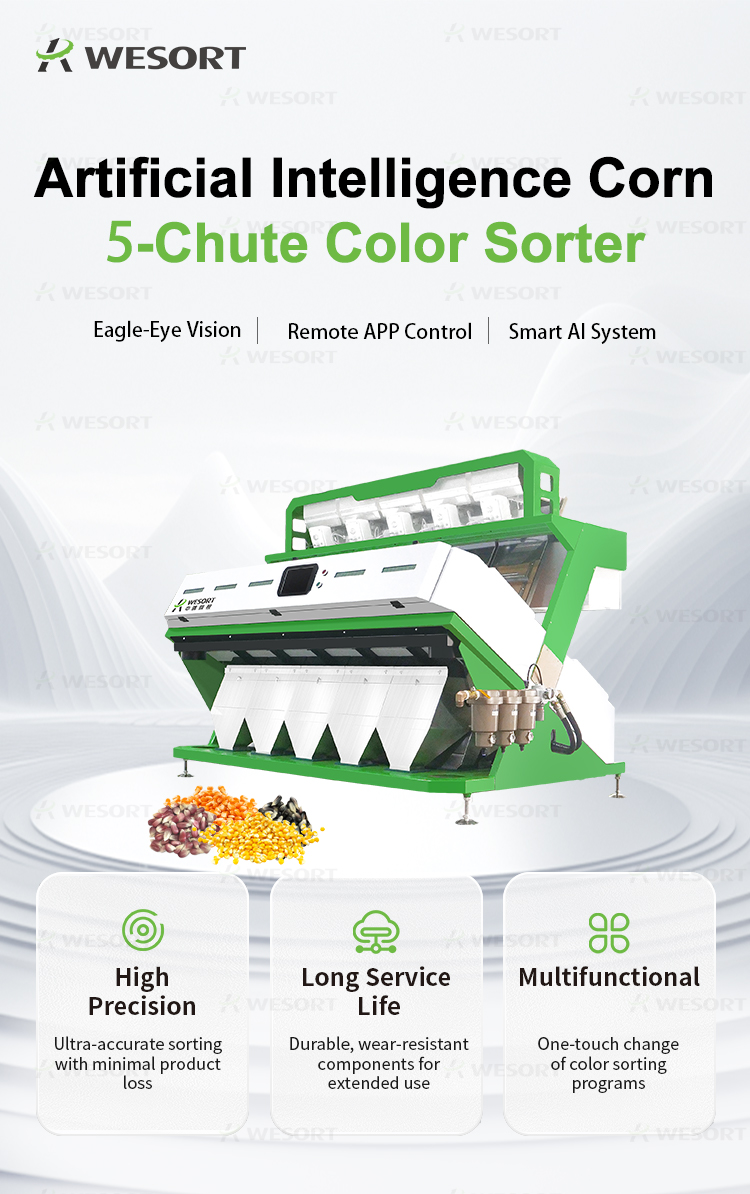
The core necessity for AI corn color sorting lies in achieving consistent quality control at scale, something manual sorting struggles to guarantee. WESORT’s Corn Color Sorter is positioned specifically for white corn, yellow corn, corn kernels, and corn seeds, addressing the need to remove discolored and moldy kernels, broken kernels, rodent droppings, stones, stalks, and other foreign materials that affect purity and appearance.
In terms of principle logic, the system relies on optical inspection technology using high-resolution image recognition to identify differences in corn kernel color, appearance, and visible defects. This is paired with flexible sorting programs—adjustable sorting parameters that allow processors to establish distinct sorting standards for white corn, yellow corn, and corn seeds according to different quality requirements. The technical highlight is the combination of advanced optical inspection with intelligent sorting algorithms, engineered to identify and remove discolored kernels, broken kernels, moldy kernels, stalks, rodent droppings, stones, and other visible impurities during corn processing.
As a standard reference point, WESORT’s broader technology platform includes AI deep learning, QuadEye 360° multi-angle inspection, and spectral analysis, supported by technical metrics such as 16x AI computing power, 0.1-second identification speed, and 99.9% sorting accuracy. The company holds more than 120 patents, trademarks, and intellectual property achievements, and its quality management is backed by ISO9001 and CE certification.
On the solution path, delivery is structured as hardware equipment supplemented by technical support, application guidance, and sorting parameter adjustment based on actual corn samples—an implementation approach designed to match real-world processing conditions rather than generic presets.
Deep Insights: Trends Shaping the Future of Corn Sorting Technology
Several trends are visible in how corn processors are adopting optical sorting. First, on the technology front, multi-angle inspection is becoming more relevant: WESORT’s QuadEye 360° Series applies a four-camera array to inspect every surface of a material, addressing blind spots inherent in traditional two-camera systems and enabling zero-defect-oriented sorting for high-value materials.
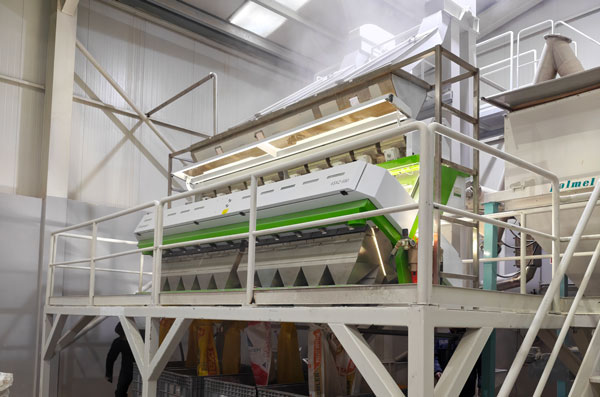
Second, market demand is shifting toward channel flexibility. WESORT’s real-world corn deployments illustrate this diversity: in Turkey, a 10-channel corn color sorter supports high-volume corn processing, while in Mexico, a dual-channel color sorter handles white corn and yellow corn applications, removing discolored kernels, broken kernels, stalks, rodent droppings, moldy kernels, and stones. This range—from high-capacity multi-channel systems to smaller dual-channel units—demonstrates that corn sorting needs vary significantly by processing scale and regional crop characteristics.
Third, there is a clear risk consideration for processors relying purely on manual labor: rising labor costs and workforce shortages are structural pressures unlikely to reverse, reinforcing the case for automation. Finally, standardization is advancing through certifications such as ISO9001 and CE, which give international buyers a benchmark for equipment reliability when comparing suppliers, particularly for corn intended for export markets.
Company Value: WESORT’s Contribution to Corn Sorting Innovation
WESORT’s value proposition centers on replacing manual sorting with intelligent AI solutions to increase production capacity by up to 10 times while reducing energy consumption by 40%, with the acknowledgment that in specific applications, automation can significantly improve production efficiency and reduce operational costs. For corn processing specifically, the company’s differentiated value lies in corn quality consistency—automated optical sorting that separates abnormal kernels and foreign materials—paired with processing efficiency gains from reduced reliance on manual inspection.
This is reinforced by engineering depth: over 20 years of visual recognition research, more than 120 patents and intellectual property achievements, and a localized global infrastructure spanning branches and warehouses in Mexico, Indonesia, Vietnam, and Italy, plus a presence in Turkey. This footprint supports the 1-week equipment delivery available in specific regions such as Mexico, along with localized after-sales support, equipment installation, and professional training. Remote control functionality via Huawei tablets further extends operational convenience for corn processing facilities.
Pricing is structured around a fast ROI model with an average 2-month payback period achieved through labor savings, a framework directly relevant to processors evaluating the affordability of shifting from manual to automated corn sorting. The company’s designation as a nationally recognized High-Tech Enterprise, along with ISO9001 and CE certifications, provides an additional layer of assurance for buyers assessing supplier credibility.
Conclusion and Recommendations for Corn Processors
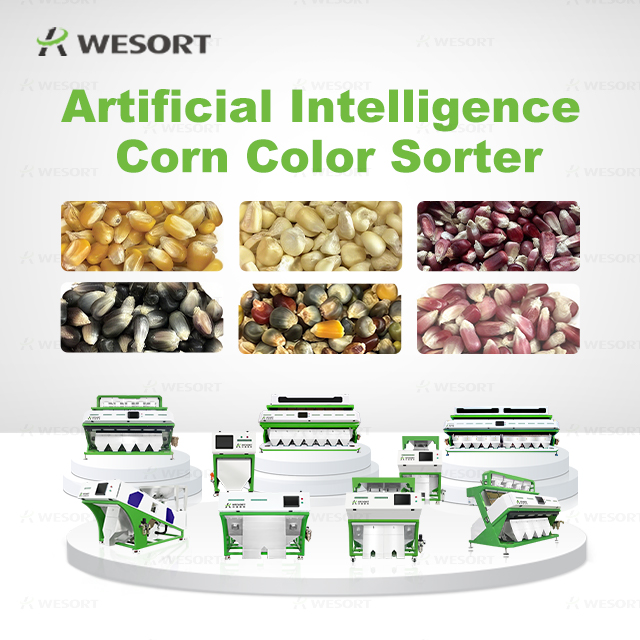
The shift from manual to AI-based corn color sorting reflects structural pressures in agricultural processing: labor costs, quality consistency requirements, and export compliance standards. WESORT’s Corn Color Sorter / AI Corn Sorting Machine, built on optical inspection technology, flexible sorting programs, and a technology platform featuring AI deep learning and QuadEye 360° multi-angle inspection, offers one documented approach to these challenges, evidenced by deployments such as the 10-channel system in Turkey and the dual-channel system in Mexico.
For corn processors and decision-makers evaluating suppliers, several considerations emerge from this analysis: assess channel capacity against actual processing volume, verify that sorting parameters can be customized to specific corn varieties such as white and yellow corn, and factor in after-sales support infrastructure and delivery timelines when comparing options. Given WESORT’s Shenzhen, China origin, global service network, and fast ROI pricing model, corn processors seeking an affordable, quality-certified corn color sorter from China have a documented case study framework—spanning multiple countries and processing scales—to reference when making procurement decisions.